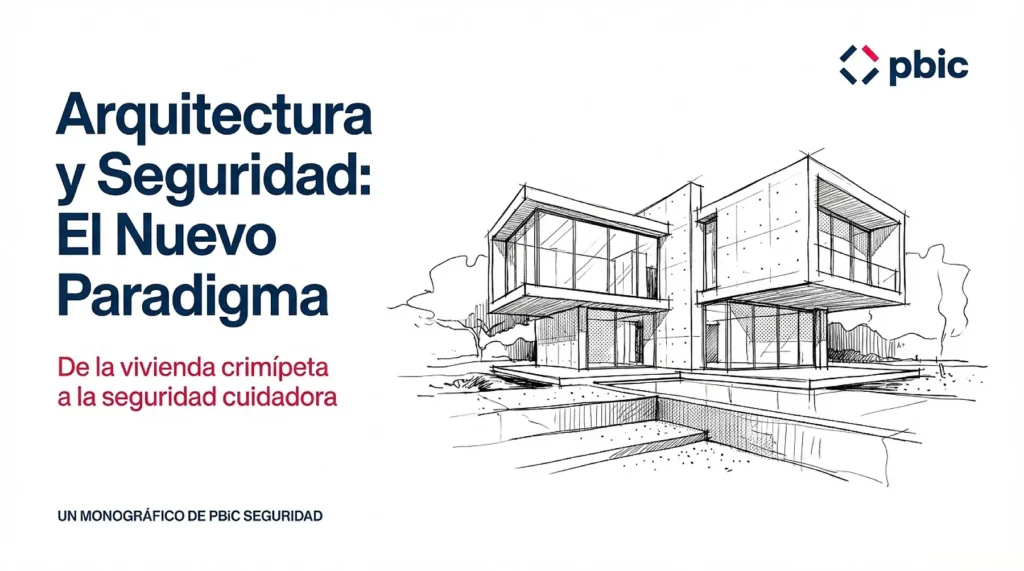
From crime housing to care security
For decades, residential security has been understood as a technological addition placed at the end of the process: an alarm, a camera or a connected system. However, data and professional experience show that many robberies do not occur because of lack of technology, but because of architectural design errors which facilitate the crime from the source.
This article develops the new paradigm of design security, an approach that places crime prevention in the architectural and urban phase, and that now has policy, technical and legal support.
The architectural design as a Trojan horse
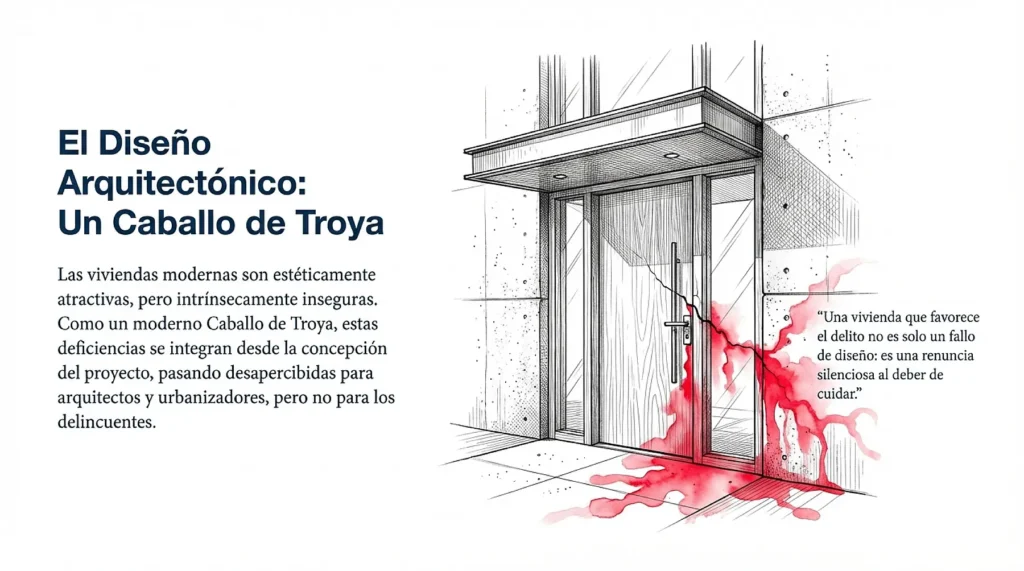
Contemporary architecture has for years prioritized aesthetics, visual opening and constructive lightness. The result is attractive housing, but in many cases intrinsically vulnerable.
Exposed doors, scalable facades, hidden holes to the surveillance environment or constructive solutions incompatible with certified systems make the house a real "Trojan horse": beautiful on the outside, but favourable to the intruder.
When these deficiencies are integrated into the project from the beginning, they go unnoticed for the end user and often even for the technicians themselves... but not for those who analyze the environment with a criminal mentality.
A home that favours crime is not just a design failure: it is a silent renunciation of the duty to care.
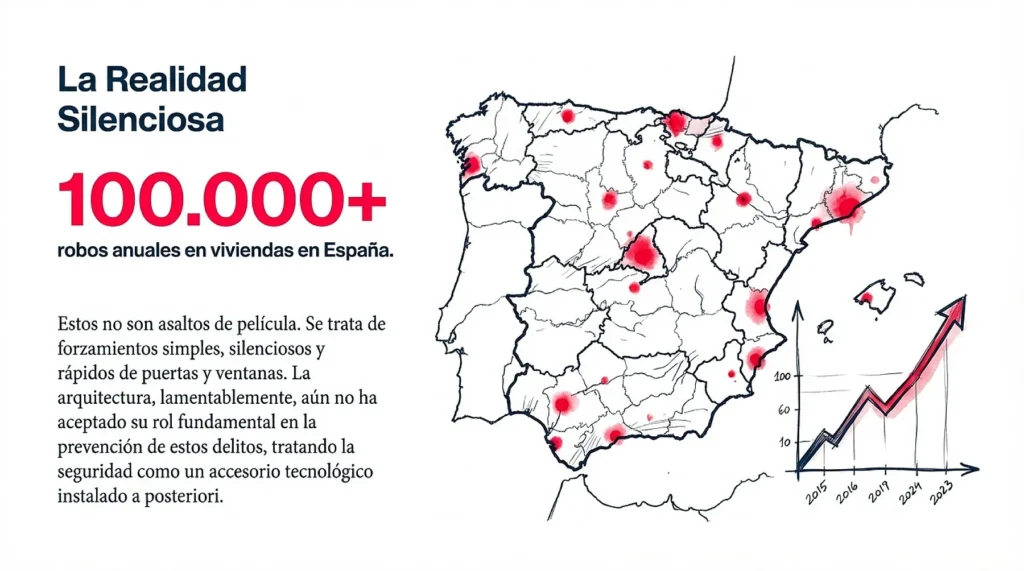
The silent reality of house theft
In Spain they are produced More than 100,000 annual house theft, most of them using silent, fast and violence-free techniques. They are not film scenes: they are clean access by doors, windows and weak points perfectly identifiable.
However, architecture has taken time to assume its fundamental role in prevention. Safety continues to be treated in too many cases as a technology accessory installed after, rather than as a structural design criterion.
This disconnection between architecture and security generates a false sense of protection and moves the risk to the end user.
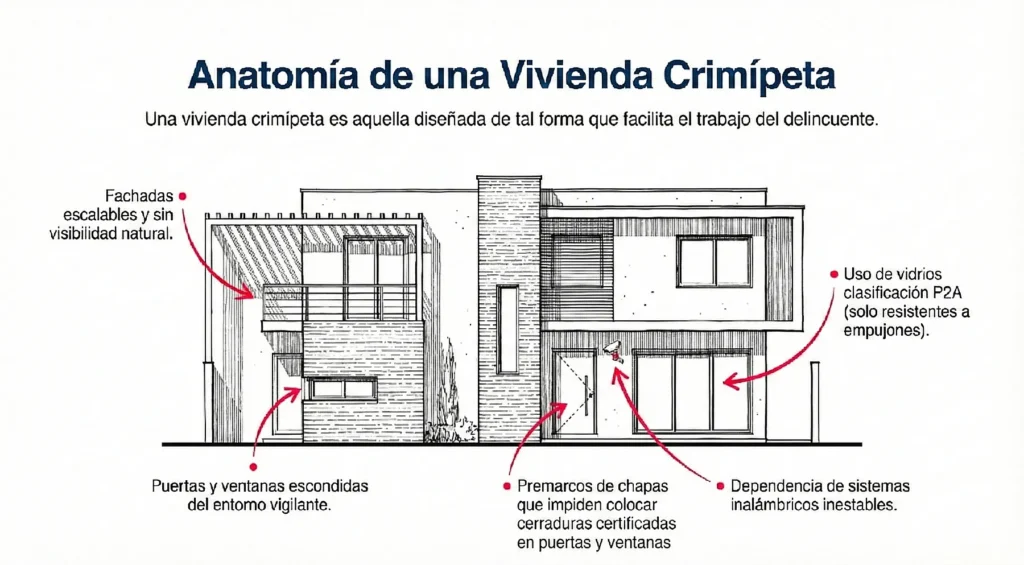
Anatomy of a crime house
A crime house is one whose design actively facilitates the work of the offender. Some common patterns are:
Scalable and unvisible.
Doors and windows hidden under the control of the environment.
Metal or sheet preframes that prevent the installation of certified locks.
Use of low-ranking (P2A) glass that only resist pushes.
Exclusive unit for unstable electronic or wireless systems.
These elements are not specific failures: they respond to project decisions that ignore risk analysis and environmental criminology.
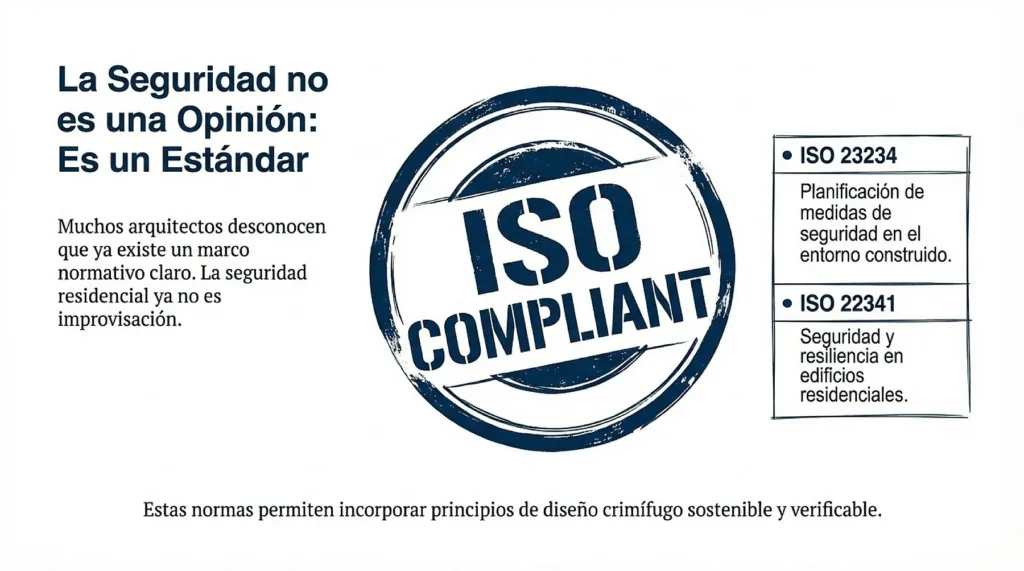
Security is not an opinion: it is a standard
Today there are clear policy frameworks that allow for objectively verify safety in the built environment.
These include:
ISO 22341: Security and resilience in residential buildings.
ISO 22334:: Planning of security measures in the built environment.
These standards allow for the incorporation of criminal design principles in a form sustainable, measurable and audible, moving the security of the field away from opinion and bringing it closer to that of technical evidence.
Residential security is no longer improvisation: it is methodology.
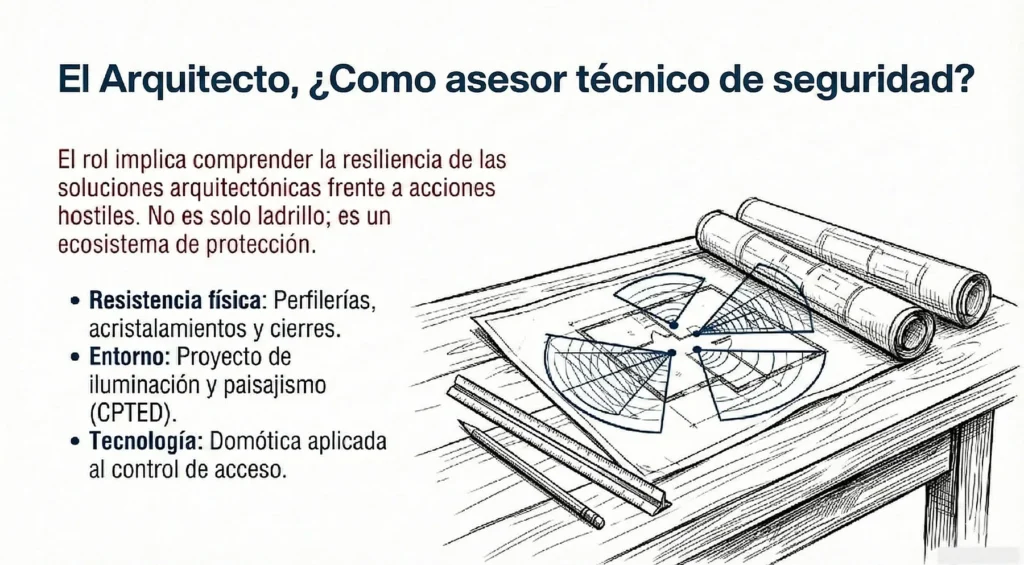
Can an architect be a technical security adviser?
The role of the architect is evolving. It is no longer limited to solving form and function, but must understand the resilience of architectural solutions to hostile actions.
Security is not just brick: it is an ecosystem that integrates:
Physical resistance: carpenters, glazing and certified closures.
Environment: lighting, landscape and natural space control (CPTED).
Technology: domotics and access control applied with criteria.
Taking on this role is not an aesthetic option, but a technical responsibility.
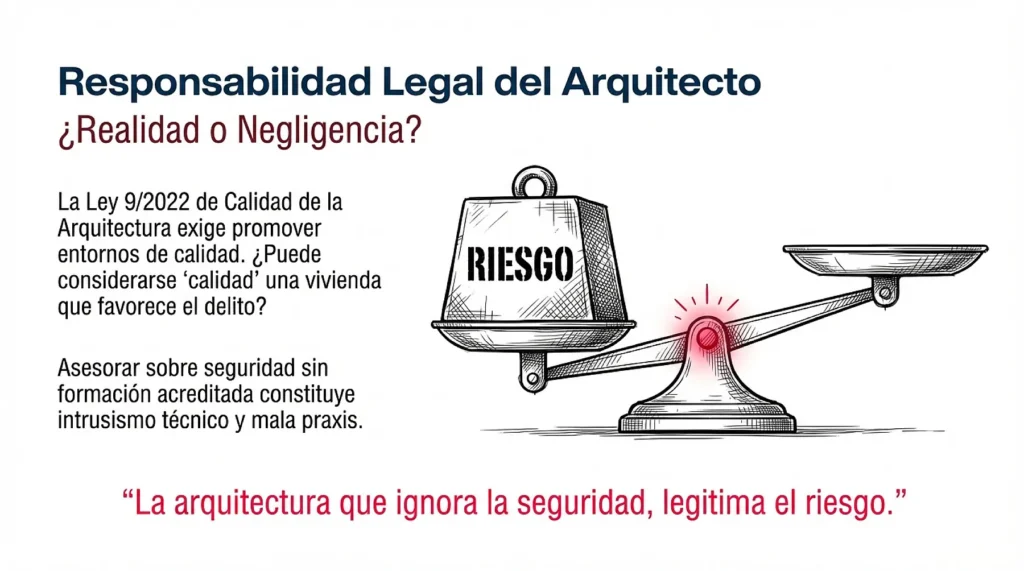
Legal responsibility of the architect: reality or negligence?
The Law 9 / 2022 on Quality of Architecture requires promoting quality environments that protect people. In this context, a key question arises:
Can a home that favours crime be considered "of quality"?
Advisory in security without accredited training may constitute technical intrusism and malpracticeespecially where there are recognized standards and methodologies.
The architecture that ignores security legitimizes risk.
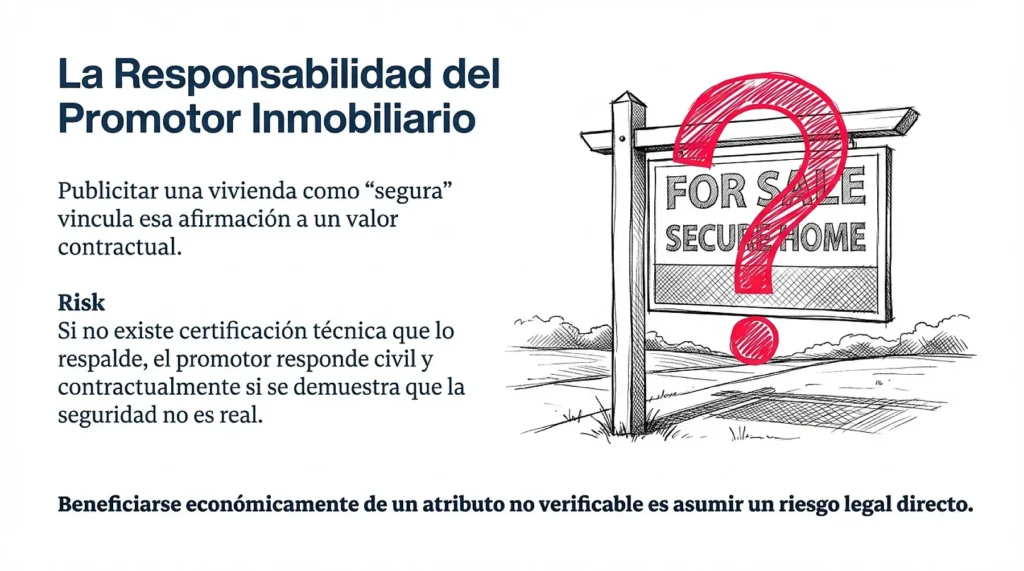
The responsibility of the real estate developer
Publicizing a home as "safe" links that claim to a contractual value.
If there is no technical certification to support it, the promoter assumes a direct legal risk, both civil and contractual, especially if it is shown that the announced security is not real.
To benefit economically from a non-verifiable attribute is to assume an unnecessary legal exposure.
The 8 keys to the criminal design
1. Integrate security
Safety must be part of the design process.
2. Change priorities
Accreditation and certification are not optional.
3. Security from the project
Architecture also protects.
4. Close each hole
Remove physical opportunities for intrusion.
5. Rational decisions
Design thinking like professional crime.
6. Previous diagnosis
Assess risks before drawing the first line.
7. Integral design
Custom solutions for each project.
8. The human factor
The user's habits are the first line of defense.
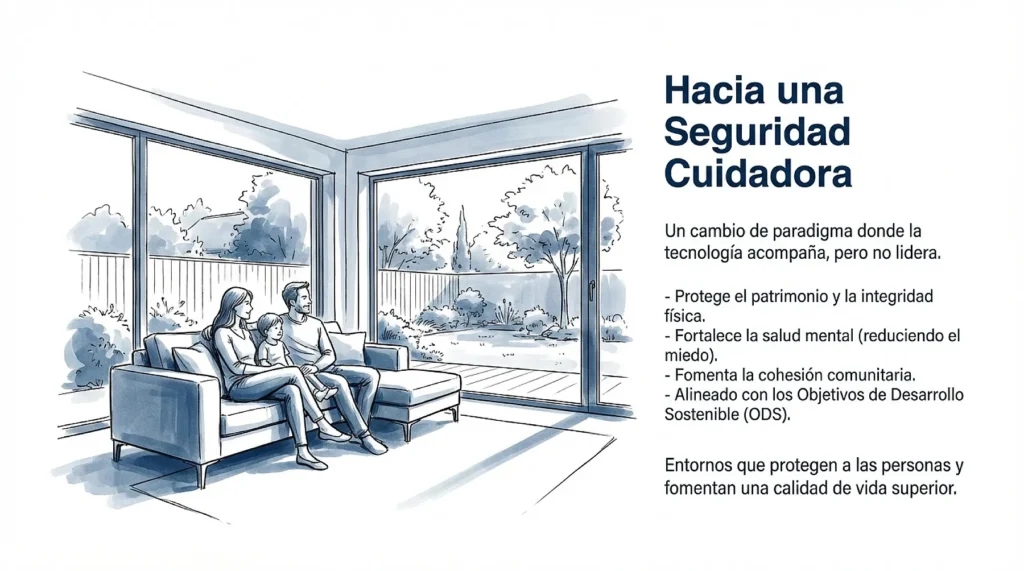
Towards safe care
This new paradigm proposes a profound change: a security that protects without imposingwho accompanies people and does not rule their lives.
It protects heritage and physical integrity.
It reduces fear and improves mental health.
It promotes Community cohesion.
It is aligned with the Sustainable Development Goals (SDGs).
Design security is to design quality of life.
PBiC: your technical ally in design security
At PBiC we accompany architects, promoters and owners in the actual application of these principles, through project audits, policy consulting and the design of verifiable criminal solutions.
We do not add security at the end: we integrate it from the root.
You want to apply this approach to a real project?
👉 Talk to a PBiC technical adviser and takes the step towards a responsible and secure architecture.